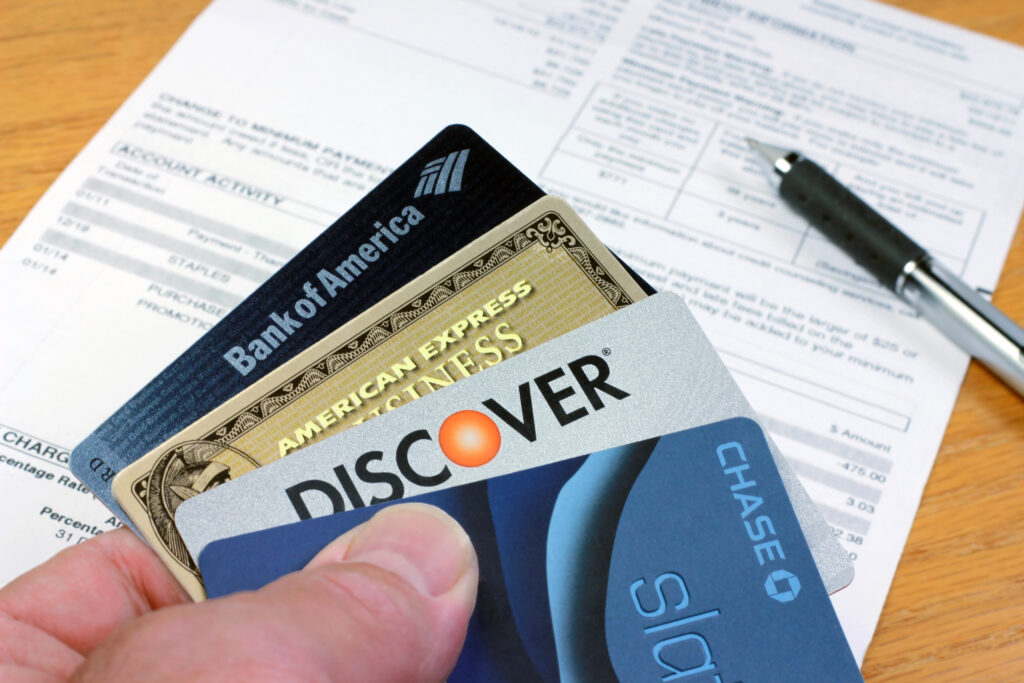
Six Chase cards show up constantly in cruise-planning circles: the Ink Business trio, the Sapphire Reserve, and the two Freedom cards. Between them, a household running ordinary monthly spending can accumulate significant Chase Ultimate Rewards points, points that convert directly into flights, cabin upgrades, and onboard credit. The math behind that only works under one condition.
The rule that makes or breaks all of this
None of these cards are worth opening unless the balance is paid in full every month, without exception. Any interest carried on a balance outpaces the value of points earned, every time; a card that earns 5% back is still a net loss the moment it carries a balance at 20%+ APR. Auto-pay for the full statement balance should be set up before the first purchase, not after the first bill.
Everything below assumes that discipline is already in place.
The no-fee starters: Freedom Unlimited and Freedom Flex
Chase Freedom Unlimited and Chase Freedom Flex both carry no annual fee and currently offer a $200 bonus after $500 in spending within the first three months, a low bar that makes them an easy first step. Freedom Unlimited earns 5% on travel booked through Chase Travel, 3% on drugstore purchases and dining, and 1.5% on everything else. Freedom Flex earns the same 5% on Chase Travel and 3% on dining/drugstore, plus 5% on rotating quarterly categories (capped at $1,500 in combined spending per quarter) that have recently included gas stations, EV charging, and select live entertainment.
On their own, these are solid cash-back cards. Paired with a card that can convert cash back into transferable points, they become something more.
The Ink Business trio
All three Ink Business cards are open to sole proprietors and freelancers, not just incorporated businesses, which makes them more accessible than the name suggests.
- Ink Business Cash: no annual fee, 5% back on office supply and internet/cable/phone purchases (up to $25,000/year), 2% on gas and dining (up to $25,000/year), 1% on everything else. The welcome offer has recently been advertised at $750 to as high as $1,000 depending on when and where the offer is seen, worth confirming the current terms before applying.
- Ink Business Unlimited: no annual fee, flat 1.5% cash back on every purchase, currently offering $750 after $6,000 in spending within three months. Chase treats Cash and Unlimited as sharing one welcome bonus: once one has been earned, the other won’t pay out a second bonus.
- Ink Business Preferred: $95 annual fee, 3x points on the first $150,000 spent annually across categories like travel, shipping, internet/cable/phone, and advertising. The standard advertised offer sits at 90,000 points after $8,000 in spending within three months, though targeted offers as high as 100,000 do circulate. Worth checking what’s actually showing on an individual account rather than assuming the published rate is the best available.
The premium card: Chase Sapphire Reserve
The Reserve’s annual fee jumped from $550 to $795 (with the authorized-user fee rising from $75 to $195), and the current welcome offer has been reported at 100,000 to 150,000 points after $6,000 in spending within three months, the largest in the card’s history at the upper end. What’s left after the fee: a $300 flexible travel credit, up to $500 in prepaid-stay credits through Chase’s “The Edit” program, a $300 dining credit, a $300 StubHub/Viagogo credit, monthly Lyft and Peloton credits, Apple TV+ and Apple Music subscriptions, Priority Pass Select lounge access, and up to $120 toward Global Entry or TSA PreCheck. Earning rates run 8x on all Chase Travel purchases (cruises included), 4x on flights and hotels booked directly, and 3x on dining worldwide.
One recent change worth flagging plainly: Priority Pass restaurant credits (using the membership at airport restaurants instead of a lounge) ended for Reserve cardholders on July 1, 2025. Priority Pass access through the Reserve is now a lounge benefit only.
Is the Reserve still worth it compared to Amex Platinum?
Less clearly than it used to be. The Reserve’s fee increase mirrors what happened to the Amex Platinum, which now carries an $895 annual fee (up from $695, effective for new applicants in September 2025 and for existing holders at their next renewal from January 2026 onward), making Platinum the more expensive of the two cards today. Both cards have also trimmed lounge-adjacent perks over time: Amex removed Priority Pass restaurant credits across its entire lineup back in 2019, years ahead of Chase doing the same. Neither card’s value proposition is what it was a few years ago; the decision between them now comes down to which specific credits and transfer partners actually get used, not a simple better-or-worse comparison.
Making the points work together
The strategy that gets the most value out of this stack: run everyday and category spending through the Freedom cards to earn cash back, then transfer those Ultimate Rewards points into a Sapphire Reserve (or Ink Preferred) account before redeeming. Points redeemed through Chase Travel from a Reserve account are worth 1.5 cents each at the standard rate, with select “Points Boost” flights and hotels reaching up to 2 cents each; transferring to airline or hotel partners instead of using the portal can sometimes stretch that further, particularly for premium-cabin flight redemptions.
For cruise-specific bookings, Chase Travel’s 8x earning rate on the Reserve applies to cruises booked through the portal directly, and select sailings marked as “Voyages by Chase Travel” carry additional perks like onboard credit or package upgrades on top of the points earned.
Pooling points across a household
Chase allows Ultimate Rewards points to be combined across accounts held by members of the same household. A concrete example of what that adds up to: opening one Freedom and one Reserve for one spouse, and one Freedom and one Ink Preferred for the other, generated roughly 300,000 combined points from welcome bonuses alone. Five years of ordinary monthly spending on top of that, without opening additional cards, brought the total past 1,000,000 points. Cardholders willing to close and reopen cards on a deliberate schedule can accelerate that further, though bonus-eligibility rules vary by card (as with the Cash/Unlimited restriction above), and doing this too aggressively has its own tradeoffs for credit history, so it’s worth understanding the specific rules before treating it as a repeatable playbook.
The 5/24 rule
Chase generally won’t approve a new card for an applicant who has opened five or more personal credit cards, from any issuer, in the past 24 months. Anyone planning to pick up several of these cards should sequence the applications with that limit in mind, prioritizing the Chase cards before opening cards from other issuers that would push the count past five.
Advertisement disclosure: The sign-up links below are personal referral links, not neutral recommendations. Applying through one costs nothing extra and doesn’t change the terms of the offer. In exchange, CruiseTea receives up to 5,000 Chase Ultimate Rewards points from Chase for each completed sign-up. That relationship is disclosed here in full, before any of the links.
Apply through:
Ink Business Preferred ·
Ink Business Unlimited ·
Ink Business Cash ·
Sapphire Reserve ·
Freedom Unlimited ·
Freedom Flex